
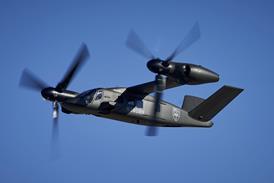















The US Army is further accelerating plans to field a new tiltrotor aircraft, with the goal of receiving the first example by 2027.
Speaking to soldiers during a 13 January town-hall-style forum, the army’s top officer said troops will begin flying the new Bell MV-75 by this time next year.
“It was supposed to be delivered in 2031 [or] 2032,” army chief of staff General Randy George says. “We said, ‘No, we need it very quickly’.”
“At the end of this year we will actually have those flying and out in [troop] formations,” he adds.
That marks a significant acceleration of the army’s timeline for fielding the new tiltrotor, which had already been moved forward from the original 2032 goal.
In May, the army told FlightGlobal it worked with Bell to move up delivery of the first MV-75 prototype to 2027, with the first frontline operator receiving tiltrotors by 2030 or sooner.
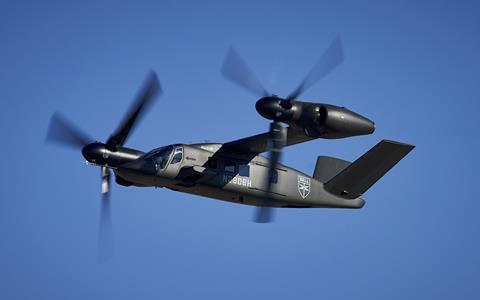
George said on 13 January that active duty national guard and special operations units may be flying the MV-75 by end-2026, presumably in a test and evaluation capacity.
Bell says it has begun assembling the first six MV-75 test aircraft in Wichita, Kansas, with eight examples under contract.
“We are proudly accelerating the production of the MV-75 fuselage, demonstrating the impact of digital engineering in reducing manufacturing timelines and enhancing productivity for critical components,” Bell said on 14 January.
The rotorcraft manufacturer eventually plans to locate final assembly of the MV-75 in Amarillo, Texas – the same location where Bell currently produces the V-22 Osprey tiltrotors it developed with Boeing. Existing US military orders will keep the Osprey line hot through the end of 2027.
US Army secretary Dan Driscoll, the service’s top civilian official, recently visited the Bell facility in Wichita and gave his endorsement of the tiltrotor – which marks the largest aviation modernisation initiative for the US Army in the past four decades.
“It’s a system built to win on the future battlefield,” Driscoll said of the MV-75 on 17 January.
How many MV-75s the army will purchase remains a matter of discussion. Originally envisioned to succeed the Sikorsky UH-60M Black Hawk, the army now plans to operate the two rotorcraft simultaneously.
In May, the army officer overseeing development and procurement of the MV-75 told FlightGlobal the current plan is to cover a little less than half of the existing UH-60M fleet.
“It doesn’t replace the entire Black Hawk fleet, but a strong majority,” Colonel Jeffrey Poquette said. “So we’re talking over 1,000.”
The US Army currently operates around 2,300 Black Hawk helicopters.