










Military aircraft manufacturer Northrop Grumman has been selected by the US Marine Corps (USMC) to develop an uncrewed fighter jet based on the Kratos XQ-58A Valkyrie.
Northrop confirmed the award under the Marine Air-Ground Task Force Uncrewed Expeditionary Tactical Aircraft (MUX TACAIR) programme on 8 January – a significant win that throws more momentum behind its autonomous fighter efforts.
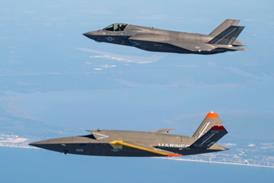
The USMC award will see Northrop acting as the prime contractor to integrate its autonomous flight capabilities into the uncrewed XQ-58A. Both the USMC and the US Air Force (USAF) have used the Kratos jet to evaluate the potential of pilotless fighters, which are known Collaborative Combat Aircraft (CCAs).
Northrop says its yet-unnamed XQ-58 derivative will work alongside crewed tactical aircraft to provide air dominance in high-threat environments.
“Northrop Grumman remains at the forefront of advanced sensing capabilities, delivering innovative solutions that meet the needs of the warfighter with unmatched speed and reliability,” says Krys Moen, the company’s vice-president of advanced mission capabilities. “This enhanced capability set ensures optimal performance for both crewed and uncrewed platforms.”
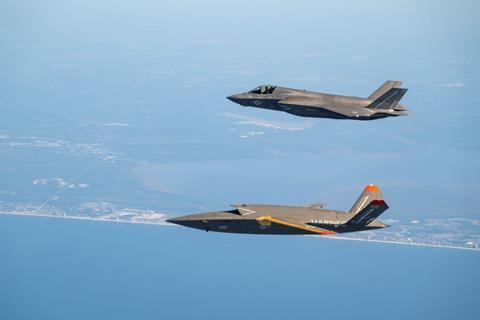
The USMC began flight testing the XQ-58 for potential operational roles in 2023, with a total of six test events funded, according to service planning documents released last October.
The trials became successively more complex, eventually involving an XQ-58 pair with Lockheed Martin F-35B fighters to collect and transmit targeting data for air-to-ground strikes during exercises in 2024.
Last August, Kratos chief executive Eric DeMarco implied that the Valkyrie had already been selected for full procurement by the USMC, with the company awaiting a formal contract signing.
DeMarco at the time described the potential financial impact of a Valkyrie production contract as “very significant” for Kratos’ tactical drones business.
He also revealed that the company already had 15 aircraft ready to deliver “immediately upon contract award”, with the potential for delivering up to 20 Valkyries in 2026.
Those aircraft will receive a new suite of Northrop avionics and sensors, and likely a new designation from the Marine Corps under the MUX TACAIR contract.
“The integration of the Kratos Valkyrie aircraft system configured with the world’s best multifunction mission systems from Northrop Grumman results in a high-capability CCA at a price point that enables the uncrewed systems to be deployed in mass with crewed aircraft,” says Steve Fendley, president of the Kratos Unmanned Systems division.
Central to the Northrop win was the packaging of existing tactical sensors and mission systems into a smaller space, which the company says will offer a cost-effective solution that is compatible with an uncrewed aircraft.
“Combining existing product lines and proven capabilities, Northrop Grumman, Kratos and commercial partners developed a missionised CCA that includes survivability, connectivity, lethality and supportability elements,” Northrop says.
The company has been maturing technologies for autonomous aviation under an internal initiative called Beacon.
Northrop says there have already been more than 20 flight demonstrations of the missionised XQ-58 variant, which it describes as a “low-risk, expedited path” to fielding an operational CCA that can support both persistent and expeditionary missions.
While the MUX TACAIR contract specifies an air superiority role, the Marine Corps previously evaluated the XQ-58 in roles involving suppression of enemy air defence missions – a high-risk speciality that involves locating, fixing and destroying ground-based radars and missile batteries.
An uncrewed fighter could take on the most dangerous portions of that mission, such as flying into defended airspace, allowing manned aircraft to remain at a safer stand-off distance.
The USAF is also pursuing an air superiority role for its first CCA, competing designs for which began flight testing in 2025.
Northrop was initially passed over for that effort, with the air force selecting Anduril Industries and General Atomics Aeronautical Systems to produce flying prototypes.
However, Northrop staged an unlikely comeback, securing late entry into the air force CCA prototyping effort with a self-funded design called Talon, which arose of out the Beacon project and was unveiled in early December.
The Talon prototype was awarded the formal designation of YFQ-48A by the USAF later that same month – matching similar monikers previously bestowed upon the General Atomics YFQ-42A and Anduril YFQ-44A.
The air force has said it plans to select the design for its first increment of frontline CCAs sometime in the second half of 2026.
A follow-on competition to deliver a second increment of autonomous jets is also in the works.