

















Europe’s big two helicopter manufacturers remain open to collaborating on a next-generation military rotorcraft in a reprise of their current NH Industries (NHI) venture, despite having markedly divergent approaches to high-speed flight.
NHI, which also includes GKN/Fokker, is responsible for the design and development of the NH90, an 11t-class rotorcraft that is still in production.
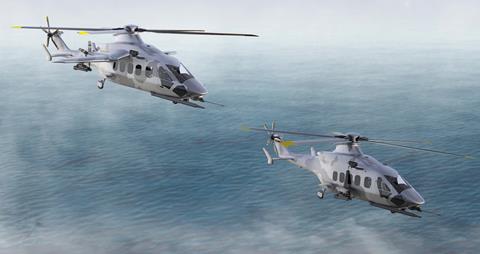
But attention is turning to what comes next, with both airframers active participants in a project led by six mostly European NATO members to develop a new military rotorcraft for service entry around 2035.
Additionally, the pair are joint leaders of a European Defence Fund-backed project, now in its second phase, to mature the technologies that will underpin such a development.
However, the solutions so far proposed for the NATO Next Generation Rotorcraft Capability (NGRC) effort suggest two wildly different, and largely incompatible, approaches: while Airbus has proposed a design based around its Racer high-speed architecture, Leonardo has pitched a 17t tiltrotor design.
Nonetheless, despite the evident differences, the leaders of both businesses are optimistic on future collaboration.
“It is not the end of the story, we have already demonstrated that we can work together,” says Bruno Even, Airbus Helicopters chief executive.
He points to the NHI consortium as a sign of what can be achieved, describing it as “one of the most successful examples of co-operation in the defence market”.
His comments are echoed by Gian Piero Cutillo, managing director of Leonardo’s helicopter division: “I think we should try, if possible, to converge,” he says.
Cutillo believes Europe must take “important steps” to secure its “technological autonomy”, he says.
“There are two companies, Leonardo and Airbus, that are at a certain level in terms of capability and competence,” he says. “We have to really get talking and see what we can do.”
Even, too, is optimistic that the pair can find common ground, should their customers – the home governments of both airframers are involved in NGRC – decide to launch a programme.
“I’m convinced that that if we are one day in this kind of situation, I don’t see a reason why we should not be able to find an agreement. It would be in the interests of both parties,” he says.
But Cutillo stresses that while “we want to find something that works for both [companies]”, any programme “has to start from the requirements”.
Even agrees, adding: “Today we are not at the point where a decision has to be taken to the launch a new programme because our customers involved are not yet clear on what will be the final requirements.”
Indeed, it is as yet unclear what priority the NGRC programme will allocate to high speed versus other capabilities, with that decision to be taken by the summer.
In addition to the Racer-derived design, Airbus Helicopters also proposed an advanced conventional helicopter as part of its NGRC concept study submission.
And Even does not think “that high speed would be the only solution” for the replacement of all the current fleet, with the capability potentially being “more of a niche in one part of the market”.
But should the nations choose to proceed and can agree on a concept “I do not see why we would not be able to partner with Leonardo,” says Even.
“We should be able to discuss and sit around the table and find the way to launch a new programme,” he adds.