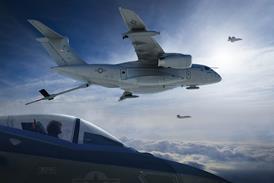
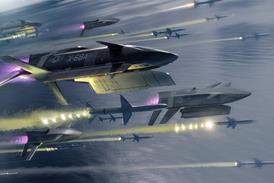















The US Air Force has issued initial development contracts for a new class of engines meant to power the emerging category of uncrewed fighter jets, known as Collaborative Combat Aircraft.
Both Honeywell Aerospace and the team of GE Aerospace and Kratos received contracts on 23 February to fund the design and fabrication of prototype powerplants that will provide thrust in the range of 800-1,600lb-thrust (3.5-7.1kN).
The announcement was made during the annual Warfare Symposium in Denver, Colorado organised by the Air & Space Forces Association.
The new category of engines are meant to be simpler, faster to assemble and cost less than the traditional large turbofans that power military aircraft. Affordability and mass production are priority attributes for the CCAs being developed by the US Air Force, US Navy, US Marine Corps and Royal Australian Air Force.
As one of the most complex and most expensive components of a jet aircraft, the choice of engine will be a key factor in meeting those CCA programme goals.
GE and Kratos have been working on their GEK engine concept since 2024, with the pair completing altitude stand testing on the 800lb-thrust GEK800 in November.
Results of that testing are being folded into the larger 1,500lb-thrust GEK1500, development of which will be funded by the recent US Air Force contract.
“Lessons learned from recent GEK800 altitude testing are directly informing GEK1500, improving thrust, power generation and life cycle cost, so we can meet CCA requirements without compromising affordability or schedule,” says Steve Russell, general manager of GE’s Edison Works advanced projects unit.
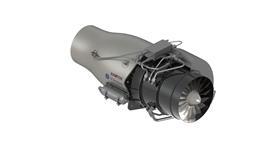
GE says the GEK1500 will be able to power not only CCAs, but also conventional uncrewed aerial systems and guided munitions like cruise missiles.
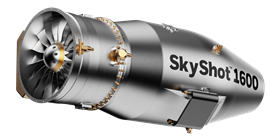
Honeywell unveiled its SkyShot1600 (previously known as the HON1600) last year, adapting the company’s existing designs for aircraft auxiliary power units (APU). Honeywell already produces more than 2,500 APUs annually.
The new engine will be significantly smaller than Honeywell’s existing F124 light fighter engine – a 6,300lb-thrust turbofan that powers seven fighter types, including the Leonardo M-346 trainer and light-attack jet.
“We’ve combined decades of proven technologies with the latest advancements to create an engine that can keep pace with cost, speed and performance demands of next-generation platforms,” says Dave Marinick, president of engines and power systems for Honeywell Aerospace.
At the 2025 Singapore air show earlier this month, Honeywell told FlightGlobal that the SkyShot engine family will be scalable from 800-2,000lb-thrust, with turbofan and turbojet options.
Currently, few options for propulsion exist in that size category, most prominently the Williams International FJ44 business jet engine. Heavy demand for a low-cost, off-the-shelf engines to support the development of CCAs has outstripped supply, spurring a race to bring alternatives to market.
Propulsion heavyweights including GE, Honeywell, Pratt & Whitney and Rolls Royce have all jumped into that race to deliver engine options that can support the affordability and production targets of the CCA programme.
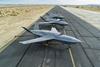
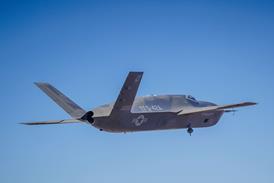
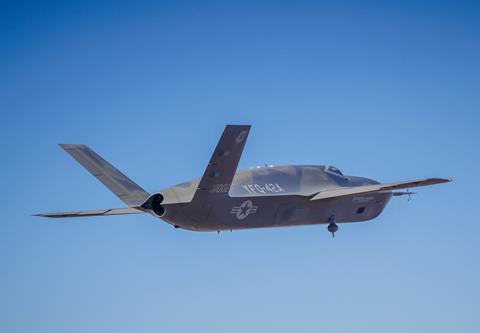
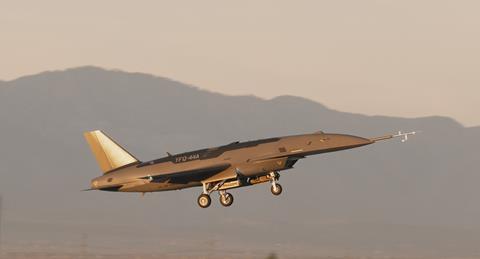
The US Air Force is currently flight testing two designs competing to be the service’s first operational CCA – the General Atomics YFQ-42A and the Anduril Industries YFQ-44A.
The Anduril jet is powered by a single FJ44. General Atomics tells FlightGlobal that its aircraft is compatible with at least 13 commercial jet engines, but has declined to say which is powering flight testing.
Boeing’s MQ-28A Ghost Bat, a joint project with the Royal Australian Air Force that has logged more flight time than any other CCA prototype, is believed to be powered by either an FJ44 or a Pratt & Whitney PW300.
The US Marine Corps in January selected the Kratos XQ-58 Valkyrie to be its first operational CCA. That single-engined type is known to operate with an engine in the 2,000lb-thrust range, indicating it will likely be compatible with the new class of powerplants.
With a total addressable market for CCAs likely in the hundreds or even thousands, supplying propulsion for the pilotless jets is set to become a major line of business for engine-makers with a ready offering.