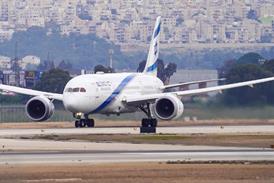













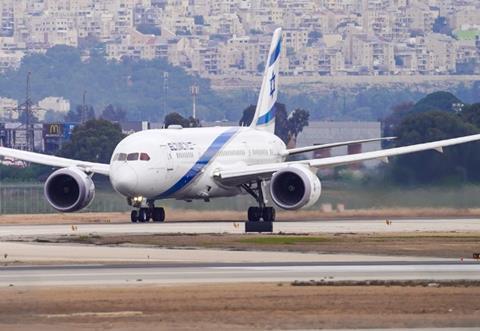
Israeli flag-carrier El Al estimates that disruption from the Middle East conflict has been directly costing the operator some $4 million daily.
El Al suspended regular flights on 28 February in the wake of the US-Israeli conflict with Iran.
Its estimate for the financial impact covers days on which it was unable to conduct any flights.
El Al says it has started operating a number of daily flights to and from Israel with a “variable scope of activity”, deploying passenger and cargo services that have been approved by authorities.
This means the direct financial damage is “reduced”, it says.
It says that it expects a “recovery process” in the period which will follow the end of the military operation and that this will result in “increased demand” for its flights and “high” load factors compared with estimates prior to the conflict.
Airspace of nine Middle Eastern countries, including Israel, should remain off-limits to carriers, says the European Union Aviation Safety Agency in a revised conflict zone bulletin issued on 18 March.
Its previous recommendations, which covered 11 states, have forced several carriers to take longer routes to the north, through Azerbaijan to avoid both Middle Eastern and Russian airspace, or deviate to the south of the Gulf.
But EASA’s latest bulletin partly eases restrictions on Saudi Arabia and Oman, providing a transit option for airlines over the Arabian peninsula.
It says that Iranian retaliatory attacks have mainly been aimed at eastern parts of Saudi Arabia while activity in Omani airspace has been relatively limited.
This means “varying levels of risk” are present in the Jeddah and Muscat flight information regions, adds EASA.
It is advising carriers to remain south of a boundary defined by two Saudi and two Omani waypoints – OBSOT, DANOM, KEDON and VELOD – and not to operate below 32,000ft in this region.