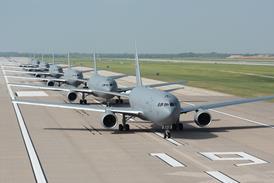













The number two officer in the US Air Force (USAF) says the service will not ink a new contract with Boeing for an additional 75 KC-46 tanker aircraft until the airframer has addressed longstanding mechanical deficiencies with the twinjet.
While the air force remains committed to the ongoing procurement of KC-46s under the service’s original 2011 contract with Boeing, vice chief of staff General John Lamontagne says a separate deal for even more of the aerial refuellers is on hold until outstanding issues with the 767-based jet have been fixed.
“We are working through a couple of issues with the contractor and we’re not going to get a new contract for another 75 KC-46s until we work through some of those deficiencies,” Lamontagne told elected lawmakers on the US Senate Armed Services Committee earlier this month.
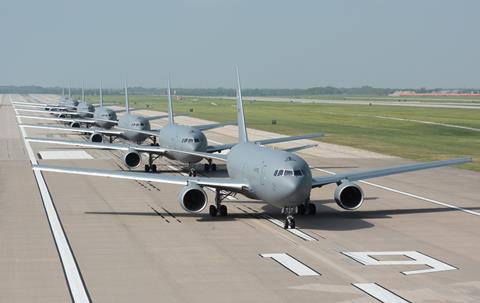
In July, the USAF announced it was exercising options to purchase 188 KC-46s under the original 2011 procurement contract with Boeing – the maximum amount allowable under that deal.
A $2.4 billion firm order covering 15 jets under Lot 12 of that 2011 deal was later definitised in November, putting 183 of the total 188 aircraft formally under contract.
At the same time, air force officials approved a new acquisition strategy for 75 additional KC-46s, for a total potential fleet of 263 aircraft.
The decision ended years of uncertainty about the USAF’s medium-term plans for modernising its tanker force, which is primarily composed of aged Boeing KC-135 Stratotankers.
For a time, the air force considered an entirely new refueller dubbed KC-Y to serve as a bridge between the KC-46 and the Next Generation Air-refuelling System (NGAS) – a clean-sheet tanker platform intended to be survivable in a modern air combat environment.
That vote of confidence in the KC-46 came after years of struggle with deficiencies on the jet, including stiffness issues with the fuel transfer boom, flaws with the Remote Vision System (RVS) that controls the boom, problems with the cargo load management software and structural cracks that temporarily halted deliveries.
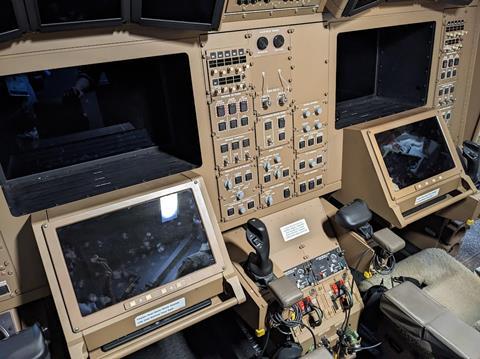
The air force had previously told Boeing to correct those issues, including ordering a full redesign of the RVS after boom operators reported adverse physiological symptoms including eye-strain and headache during testing, according to the Air Force Research Lab. Boom operators also ”frequently struck the receiver aircraft outside the receptacle” during evaluations of the RVS, the AFRL notes.
”The KC-46 RVS 1.0 design resulted in degraded air refuelling performance relative to the legacy tankers,” the AFRL says, noting the system was assessed with two Category 1 deficiencies – the most-severe category of design failure, denoting issues that could cause severe injury or death to personnel, or the loss of aircraft.
Boeing began flight testing on an updated RVS 2.0 design in late 2025.
The company has racked up in excess of $8 billion in losses owing to the KC-46 programme. Originally, Boeing bid it as a fixed-price contract that allowed little margin for the ballooning costs and production delays generated years later by the Covid-19 pandemic.
In light of those issues, Congress restricted retirements of KC-135s. It imposed temporary limits on acquiring new KC-46s until the air force develops a corrective to resolve all Category 1 deficiencies with the aircraft.
Despite the many headwinds, the KC-46 was certificated by the USAF for global combat use in 2022 and is actively supporting frontline operations.
Senior officials, including the cabinet-level secretary of the air force Troy Meink, have repeatedly expressed support for the 767 derivative.
“KC-46 is a great airplane,” Meink said at the Air & Space Forces Association Warfare Symposium in February. “There are some challenges and they’re working through them.”
Lamontagne, who previously headed the Air Mobility Command that manages the air force’s tanker fleets, says he is “confident that a good plan is in place” for addressing the mechanical shortcoming and continuing the KC-46 acquisition programme.
“We’ll deliver [the plan] here next year,” he says.
A contract for the second tranche of 75 KC-46s will then follow in “subsequent years”.
Lamontagne also revealed that the USAF is in the process of permanently transferring additional KC-135 tankers to Eielson AFB in Alaska, where they will support fourth- and fifth-generation fighters from both the US and Royal Canadian Air Forces, which are increasingly being called upon to intercept air space incursions by Russian military aircraft in the Arctic.