

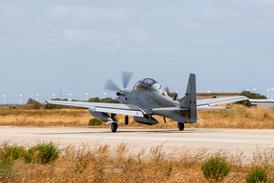














A new turboprop-powered light-attack and surveillance aircraft could be on the cards after the European Defence Fund (EDF) outlined plans to invest €15 million ($17 million) in early-stage design work for such a platform.
Contained within its latest call for proposals, published on 17 December, the future multirole light aircraft (FMLA) is seen as a key requirement for future asymmetric conflicts or counter-insurgency operations.
“There is a need for a new multirole light aircraft that can bridge the gap between today’s battlefield and modern technology as most of the EU’s fleet in this segment is ageing,” the call document states, identifying those aircraft as mostly “30-40 years old”.
“It should provide a cost-effective alternative solution for those countries that cannot afford to operate expensive modern air assets,” it adds, providing, where possible “a platform for a range of kinetic and non-kinetic weapons”, including “precision-guided munitions”.
Primary missions for the FMLA are seen as air-to-ground operations, light attack, drone interception and close air support. It should also be capable of fulfilling ground targeting, and intelligence, surveillance and reconnaissance (ISR) needs.
“FMLA is expected to become increasingly valuable due to its versatility, lower operating costs, and adaptability to emerging mission needs,” according to the call document.
Seen as a turboprop-powered platform with a maximum take-off weight of no more than 7,500kg (16,500lb), the FMLA should also have short take-off and landing performance and be capable of operating from unpaved airstrips.
Additionally, the EDF says the aircraft should be capable of flying in a broad set of challenging weather and environmental conditions “ranging from sandy, dusty, salty, stormy, hot and humid to extremely cold environments, including high-winds, gusts, extreme rain and mountainous terrain”.
Novel materials and “clean” propulsion should also feature, and it should be “equipped with cutting-edge radar applications and adaptive camouflage to extend its survivability”.
Beyond its core battlefield role, the FMLA must also be “easily converted to meet civil security and EU internal needs” such as search and rescue, border surveillance and natural disaster relief missions.
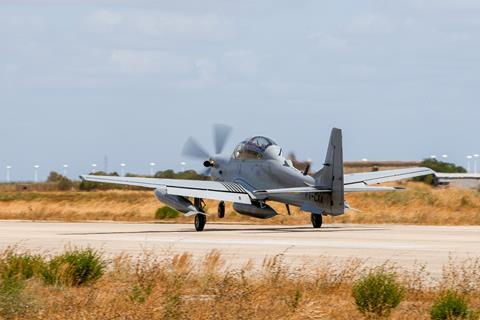
As part of the project, analysis should be conducted of the aircraft replacement need in the space in the 2035-2040 horizon. Some nations have already begun the replacement process, with Portugal, for example, investing in the Embraer A-29N Super Tucano, five of which were handed over earlier this week from a 12-unit commitment.
Funding for the FMLA is part of a wider programme of work proposed by the EDF which intends to allocate €1 billion across 31 different topics.