









Defence contractor Lockheed Martin plans to reveal in January the details of its bid to take over basic rotary-wing training for the US Army.
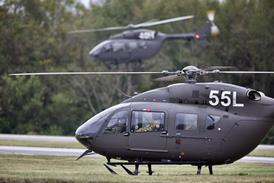
That includes announcing which aircraft Lockheed will propose as a replacement for the Airbus Helicopters UH-72A Lakota, a source within the company tells FlightGlobal.
The US Army is seeking to drop the Lakota as its primary trainer, only five years after the UH-72A achieved that distinction.
Lockheed has previously said it will use a third-party aircraft in its bid for the army’s Flight School Next (FSN) tender, which is seeking a contractor to take over all aspects of the army’s current Initial Entry Rotary-Wing (IERW) instructional programme.
That will include curriculum development, cockpit and classroom instruction and fleet sustainment, as well as providing a new fleet of rotorcraft.
“We work with the customer and find the right platform, which is different than making a platform and telling you that’s the one you have to have and then try to design training around it,” Eric Carney, Lockheed’s director of strategy and business development for air and commercial solutions, told FlightGlobal in May.
While the identity of that aircraft will now be withheld until 2026, Lockheed is sharing additional details of its FSN plans.

The company now says its proposal for the US Army will be heavily influenced by similar “turnkey” flight training programmes Lockheed manages for Australia, Singapore and the UK.
“A lot of work has gone into building the training system to be affordable, scalable, and to address the basic training needs, which is really centered on going back to basics,” says Peter Ashworth, director of global training systems for Lockheed Martin Australia.
A former aviator in the Royal Australian Navy (RAN), Ashworth tells FlightGlobal that Lockheed applied that approach to the fixed-wing instructional programmes the company runs for the Australian Defence Force and Republic of Singapore Air Force.
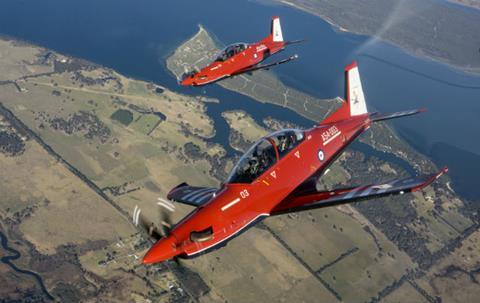
Using a fleet of 49 Pilatus PC-21 turboprops and nine simulators, Lockheed provides basic fixed-wing instruction for all new aviators from the RAN, Australian Army and Royal Australian Air Force.
The company currently trains 120 pilots per year under Australia’s AIR5428 programme.
Singapore was the launch customer for the PC-21 trainer as part of the Singapore Basic Wings programme, which Lockheed has managed since 2008 in the Western Australian city of Perth.
In Europe, the company manages the UK’s Military Flight Training System, which includes both rotary- and fixed-wing instruction.
Based on that experience, Ashworth says Lockheed has found there are three attributes that a successful flight-instruction programme needs, in addition to safety.
“They want quality, so they want the graduates trained to the requisite level of skill that they need, [and] they want timeliness – fixed time periods to get students through their courses,” he says.
“But also it’s got to be efficient and cost-effective,” Ashworth adds.
Lockheed, he notes, is hitting more than 98% of its key performance metrics on the Singaporean and Australian programmes.
That experience will likely be compelling for the US Army, which has cited runway instruction costs under the IERW programme as a primary impetus for Flight School Next.
The service’s current flight training scheme is divided up under multiple separate contracts, which each covering different aspects of the instructional programme, including fleet maintenance.
Via FSN, the army now wants to consolidate all of those functions under a single entity.
There is a crowded field competing for the lucrative contract, which has been estimated to be worth around $1.5 billion in revenue annually for the winner.
Many of the contenders are aircraft manufacturers who have built a proposal around one of their own rotorcraft, including Bell with its 505, MD Helicopters with a 530F offer and a bid from Robinson based on the R66.
Leonardo’s TH-73 had been looked at as a frontrunner for the Lockheed bid, but the airframer announced in July that it was partnering with Boeing on a FSN offer.
A derivative of the AW119k light-single, the TH-73 is already in service as the primary trainer for new pilots from the US Navy, Marine Corps, and Coast Guard.
Leonardo tells FlightGlobal that it wants to compete for the US Army trainer opportunity as a sub-contracted aircraft supplier and sustainment provider, rather than a prime contractor.
It is not uncommon for individual defence manufacturers to sign on as a sub-contractor to competing proposals for a competitive procurement opportunity, so an additional TH-73 proposal is not beyond possibility.
What is known is that the aircraft will be a relatively simple, single-engined type.
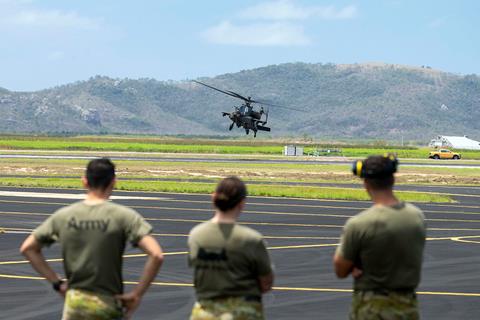
US Army leaders are blaming the twin-engined UH-72A for an uptick in safety mishaps amongst new pilots that has occurred in the years since the Lakota’s adoption as a trainer.
They view the Airbus type as being overly automated to effectively teach foundational “stick-and-rudder” flying skills, while the operating a twin generates extra costs that are not necessary for basic instruction.
“We want to go to a simple, single-engine, basic helicopter so that our pilots, when they come out of flight school, they are expert pilots,” said army vice chief of staff General James Mingus at 2025 Army Aviation Association of America conference in May.
Airbus has pointedly rebuffed those army’s critiques of the UH-72A, noting the pilot-assisting automation features can be reduced or switched off – something the company claims the army has not pursued.